Showing posts with label HOMESCHOOLING. Show all posts

Thursday, July 05, 2012

a long way down the track

Phew, this is a long post!But then it was a long trip. And once you have viewed all the pictures you can congratulate yourself that you have traveled most of the length of the north island(because who knows about anything north of Auckland, apart from the Bay of Islands...which are not even on the beautiful west coast of northland that I am so proud of...but I digress...)


We left Wellington early in the morning.Driving up to the kapiti coast we passed through several tunnels.(tunnels do not make for good photos so you will have to take my word for these.All of that is wrapped in family memories,trips on trains to Johnsonville,Khandallah, to the city with my cousins,Mary and Joan.Sadly I haven't seen Mary for years and she was not able to make it to her mother's funeral. Well wherever you are Mary I wish you joy and happiness and some amazing views. You were an important part of my childhood and I hope that goodness follows you and surrounds you.

Back to our trip. Because the train only stopped at  six stations(including Wellington and Auckland) we were fortunate to have Duncan narrating for most of the journey. The train was in the process of refurbishment and they planned to have taped commentary happening soon. Personally I think we were lucky to have Duncan as he spoke with humor and personalized what could have ended up as "just another travel log"
The trip started cool with a promise of cooler to come!Everywhere was green and lush and familiar New zealand countryside and farm houses sped by.

            
 "The long train moves: we move in it along.
Like an old ballad, or an endless song,
It drones and wimbles its unwearied croon—
Croons, drones, and mumbles all the afternoon."


As well as fully air-conditioned(think heated) carriages, at the rear of the train was a wonderful surprise:the viewing coach, which was completely open to all weather experiences and great photographic opportunities.
Here is ds again in the viewing coach. He spent most of the 10 hours there, finding and making friends and coming in to sit with us only when hunger or thirst needed another response.
As I said earlier ...it got colder!


"Faster than fairies, faster than witches, 
Bridges and houses, hedges and ditches, 
And charging along like troops in a battle, 
All through the meadows the horses and cattle: 
All of the sights of the hill and the plain 
Fly as thick as driving rain; 
And ever again in the wink of an eye, 
Painted stations whistle by."
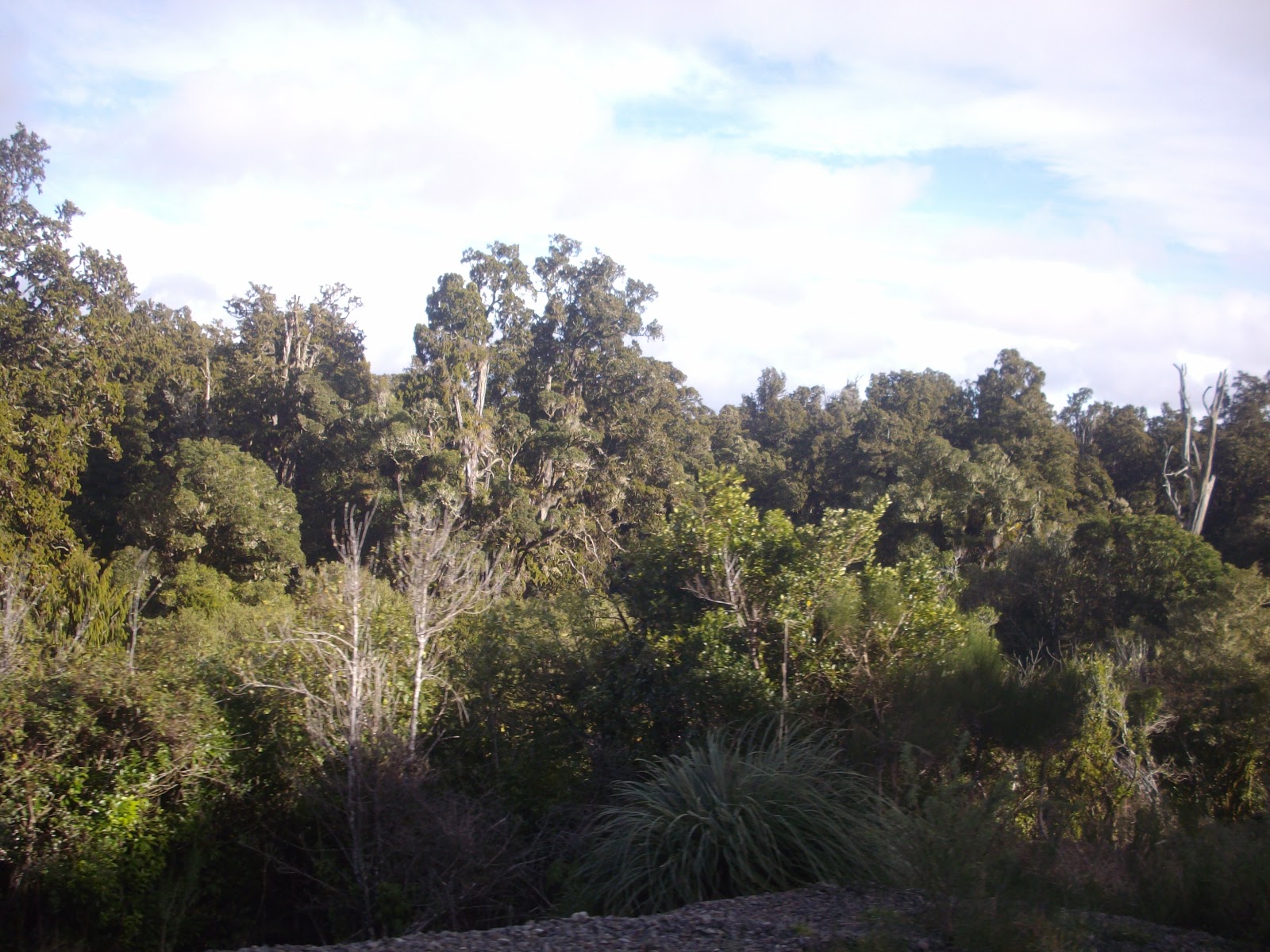
heading in to National Park, the vegetation changed

And getting closer we saw a ...


Along the way, we saw fantastic views of New Zealand farmland, rugged bush landscapes before ascending up the world famous Raurimu Spiral to the volcanic plateau passing the majestic volcanoes of Mt Tongariro, Mt Ngauruhoe and Mt Ruapehu.


"In the final push to close the gap in the North Island main trunk line, the railway had reached Taumarunui by 1904. To the south lay the imposing ascent onto the Waimarino plateau. After much difficulty, civil engineer Robert Holmes came up with a remarkable answer. He designed the Raurimu spiral, which included two tunnels, three horseshoe curves and a complete circle."


Coming into the Waikato district the scenery changes
poor photo but it shows the small volcanic hills visible in this terrain.

And so in a single day we travelled past every kind of scenery there is, from coastline to volcanoes to mountains, from lush green farmland to thick New Zealand bush. an epic 681 kilometre (423 mile) journey!

Monday, July 02, 2012

Outside Te Papa

 Outside Te Papa is a bush walk complete with a cave including glow-worms and stalagmites and stalegtites.
 we wandered over a swing bridge,
 investigated some rock and fossil formations,
 explored a cave or two! We walked amongst preschoolers from a Te Kōhanga Reo. It was wonderful to hear the little ones chatting(and even giving cheek to their supervisors!) in their own language.

 Te Kōhanga Reo is a total immersion Māori language family programme for young children from birth to six years of age.It was begun in 1981 by the Department of Māori Affairs in response to Māori concern to ensure the continuing survival of the Mäori language.At Kohanga Reo all education and instruction is delivered in te reo maori.
 
 Later in our New Zealand visit we were privileged to stay with a couple whose grandson is attending one of these maori language nests."More than half of the world's 7,000 languages are expected to die out by the end of the century, often taking with them irreplaceable knowledge about the natural world, Harrison said."Harrison and Gregory Anderson""Most of what we know about species and ecosystems is not written down anywhere, it's only in people's heads"Harrison and Gregory Anderson.When a language is lost, centuries of human thinking about animals, plants, mathematics, and time may be lost with it.(ref:http://news.nationalgeographic.com/news/2007/09/070918-languages-extinct_2.html)


Wednesday, May 23, 2012

Wittunga Botanic Garden


Because May is local history month in our state, we took a tour with some others, including a few homeschooling families, through one of our botanic gardens. The talk focused largely on the family that had bequeathed the gardens to the state but we also delved further back in time.We enjoyed hearing about Sir Joseph Banks and discovered the "interconnectiveness" of people who share interests and live around the same time. We found banks too often be this link.

I love the look of the mallee here amazing to learn:The mallee display one of the most impressive adaptive features in the form of the confusingly named mallee root.  The mallee root - also known as a lignotuber - is not a root at all but is essentially a very contracted underground trunk which grows just below the soil surface and from which the stems arise.  It acts as both a storage and reproductive organ. 


 Its storage function is principally of carbohydrates, essential nutrients (such as phosphates) and some water so that the mallee, once mature, can survive long periods without rain.  Its reproductive function takes the form of multiple growth points from which new shoots can rapidly develop (drawing on the carbohydrates and nutrients) should the above-ground parts of the plant be destroyed by fire or other natural catastrophes.  Most other species of Eucalyptus have similar epicormic shoots on their trunks and larger branches from which new shoots can develop after fires but the mallee protects the trunk from fire and so is much more energy and water efficient.  


Our guide shared some amazing wood turnings he had done with banksias

We were also lucky after the walk to spot 4 koalas in the park. Now this does not cover a large area and two of those we saw were only a tree away from each other. This puzzled us as we had always thought koalas were territorial Definitely need to do more research on this!


We seem to have more succulents in our photos than any other plant type and these were not mentioned in our guided tour at all. But we find them rather interesting, so please bear with us!
"Located in the leafy foothills suburb of Blackwood, Wittunga Botanic Garden contains stunning displays of water wise plants from Australia and South Africa which are especially spectacular in spring.


Established by Edwin Ashby in 1902, the Wittunga Botanic Garden devotes 14 hectares to indigenous and non-indigenous collections. Native birds are attracted to the garden's flowering plants and the shady lawns make Wittunga Botanic Garden a popular setting for family gatherings and lakeside picnics.


The centrepiece of the garden is an attractive lake that separates the Australian native plants featuring banksias, grevilleas and hakeas from the South African plants of proteas and leucadendrons on the opposite side. The garden also features a butterfly garden and a grey box woodland planting, endangered in South Australia."