Showing posts with label PICTURE BOOKS. Show all posts

Saturday, February 25, 2012

Monsoon Afternoon


As part of our ongoing study of Asia we read Monsoon Afternoon by Kashmira Sheth.. While this was probably designed for a younger reading age both boys examined the artwork with delight. We liked the note at the end of the book which described how the monsoon in her childhood meant the end of the mango season and the start of school.We nearly always read these notes by authors at the end of books as they either add to the information within the text or as in this case give us a peek into the authors own life. Altogether this is a very pleasant book to read. The text in which the small boy asks his grandfather a series of questions is beautifully complimented by the watercolor paintings of the artist.


Monday, October 17, 2011

"The Genius of Leonardo" picture book find

I love to use picture books as an introduction or summary of a particular topic. I was surprised and delighted to find this at our local library. As part of our readings for history we are reading "the Second Mrs Gioconda". This book is a fictional representation of the life of Leonardo de Vinci. (Now I have heard some negative reviews by homeschoolers of this book because it mentions one character's unfaithfulness to his wife but again I think if you are reading this to older children it can give you a good opportunity to discuss such topics as trust and commitment. Again I don't think a book has to ascribe to my world philosophy for it to be worthwhile in our homeschool. )
I enjoy reading books by E.L Konigsburg for myself but I think she is a fabulous author for older children.Books by her always encourage lots of discussion!
However back to my picture book find. It is described as being written by Guido Visconti with quotations from the notebooks of Leonardo. The artist's illustrations are supurb. one reviewer says:"When I first saw the cover and title for this book, I was pretty sure I wasn't going to like it. The illustrations did not remind me of Leonardo Da Vinci. I was ready to be disappointed. Instead, I was surprised when I found myself enjoying the book.

I like the portrayal of Leonardo and his apprentice. The genius of the man is portrayed while still keeping him imperfect. Leonardo doesn't have answers for all of life's questions. Still, the book reminded me how fascinating math and science can be while reminding me why the Renaissance is such a fascinating time in history.
All around, this is a wonderful book."
another states"The illustrations by Bimba Landmann are amazing, making the book a work of art. The text is meaty, telling us a lot about Leonardo and his ideas (with direct quotes). Kids will relate to the mischievous character of Giacomo, Leonardo's 10-year-old assistant, who frequently annoys his famous boss. I would recommend this book for anyone age 6 to adult!"(reviews from Amazon)I think this is a book worth re-reading long after our history study has been completed.

Friday, December 17, 2010

Picture Book Advent :The Fir Tree by Margaret Wise Brown


 Copybook Phrase:I’m not too little and not too big. Not too stiff ,nor yet too limber. A beautiful little green fir tree. Just the tree for Christmas to grow with.

No new activity but phrase could be attached to our Christmas tree.
A sweet story by one of our favourite picture book authors: Margaret Wise Brown.(aka “Goodnight Moon “ fame)


Sunday, December 05, 2010

Picture Book Advent :"The Stone" by By Dianne Hofmeyr, Jude Daly


 A retelling of the story told to Marco Polo about the Magi of Saveh, three wise men from a town in Persia, who followed a strange star and find a special child. Marco Polo described the tombs of the Magi in his travel book, Il Milione:
"In Persia is the city of Saba, from which the Three Magi set out... and in this city they are buried, in three very large and beautiful monuments, side by side. And above them there is a square building, beautifully kept. The bodies are still entire, with hair and beard remaining."


Love this book! The story of the three kings but told in a less usual though in my opinion highly acceptable way! 
It fits in/ties up so neatly and profoundly our geography study of the middle east.Leaves us with thoughts to think on and actions to take! Highly recommend it!
Evocative images add to the Persian atmposphere. I love the ending. A great take on the impact of Christ’s light within us shing out to the world:

"then each person carried the flame away,back to all the faraway places of the earth,for all mankind to share.”

Copybook:
Balsar’s eyes shone:”The child accepted all three of our gifts. He must be all three things..”
“What three things?” demanded Jasper.
“The true king. The true healer and the true Holy One.”

Wednesday, December 01, 2010

Picture Book Advent :Little One We knew You’d Come


Wonderful book. Love the lyrical way it is written and the illustrations which beautifully match the theme. We shouldn't have been surprised as the author writes one of our favourite children's Bible
And do check out the web site of the illustrator. she has some beautiful images there. I love the hint of something medieval, almost make-believe in them.

Little One we knew you’d come.
We hoped. We dreamed. We watched for you.
We counted the days till you were due. We waited. How we longed for you,
 And the day that you were born.


Little on we know you’ll come.
We hope . We dream. We watch for you.
We count the days till you are due.
We wait. How we long for you.
And the day that you were born.


 ACTIVITIES:
Copybook or calligraphy the following:

And every year, we remember you, our miracle child, our dream come true.
Oh how we thank heaven for you.
And the day that you were born.
Little one we’re so glad you’ve come.
                  From Little One We knew You’d Come.    By Sally Lloyd-Jones illustrated by Jackie Morris.

MEMORY WORK:
 memorizing our scripture from Luke Chapter Two:

MUSIC:


Learn + play some hymns:
specifically we will learn these carols; "Joy to the World',"We Three Kings","God Rest Ye Merry Gentlemen" on violin
we will also listen to and revise the words of "People look East""O Come Emmanuel""Lo he Comes""O Jordan's Bank""On this Holy Mountain""Lo How a Rose"


CRAFT:
Make angels for gifts
Make advent box
Sew stars to hang on noticeboard + on tree. Use buttons + sequins: need lavender/purple/red/lime green felt,       need purple + green thread  + need needles + templates

Thursday, June 17, 2010

Jean Craighead George


I remember being introduced to this author at Teachers Training College. There I devoured two of her novels not realizing that there were more about Julie or that she also wrote picture books.


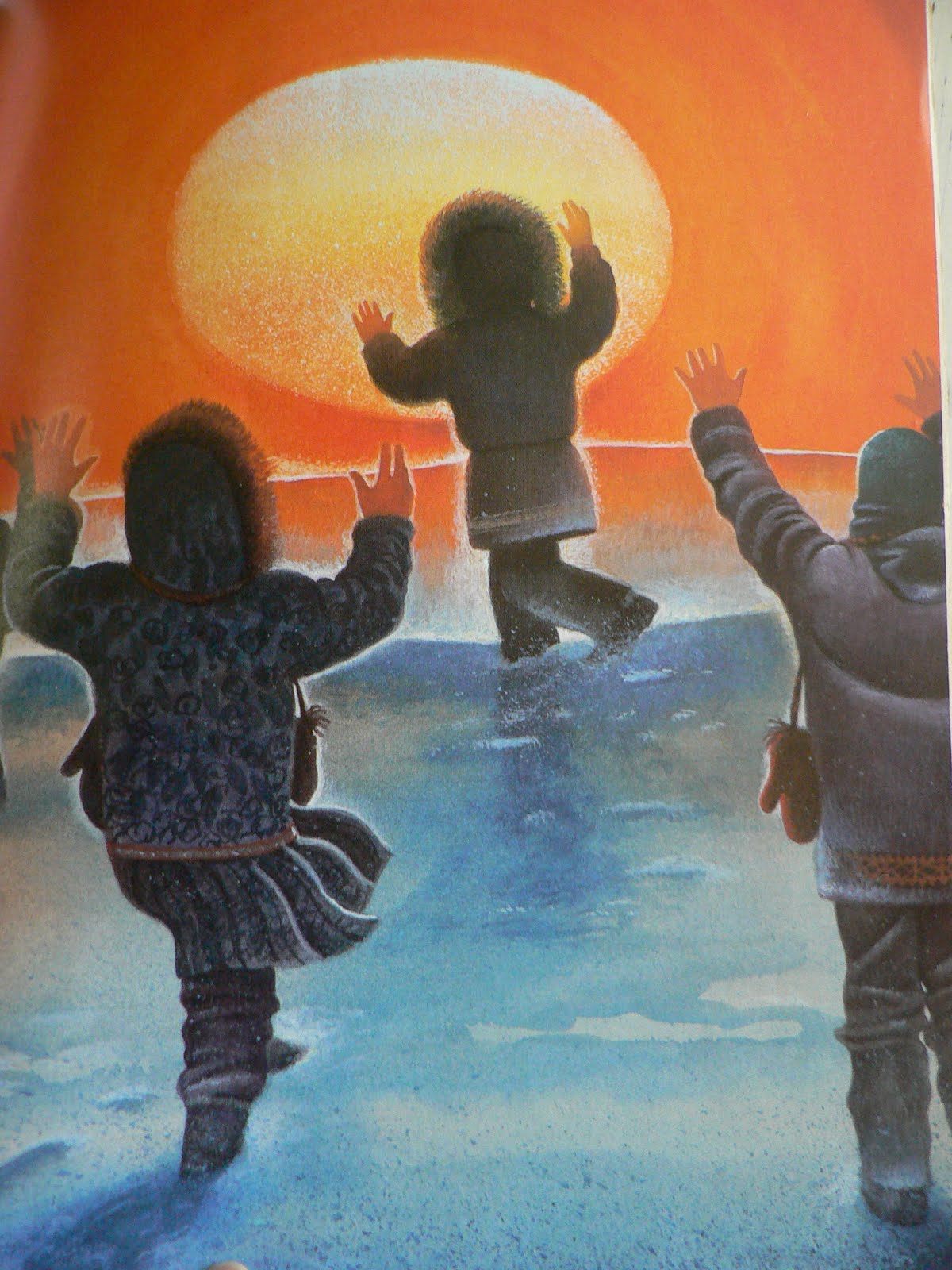
Although the part of the world this story takes place could not be more removed from the geography of the region we are studying(the Middle East) it somehow fits in with the season here(winter).


And reading about somewhere snowy and cold somehow makes a grey winters day seem more cozy!
Like all of Jean's books the language is rich and worthy of comment:the wind didn't just blow hard, it "bugled like a lost caribou calf".The town where Luke lived was "not more than a polar bear's trot from the North Pole." We are introduced to the culture of the Inupiat people through their language:""Alappaaq," he said to his teacher."It is cold." and their lives in relation to the cycle of the seasons:"They are telling us winter is coming,"Aalak said."And winter is very serious."

Wednesday, June 02, 2010

The rainbirds

We often read picture books in our homeschool, even though my children are now 13 + 9. I find picture books are a very useful tool. Because they are by definition short in text they are perfect for Charlotte Mason style short lessons. They have to, again because of size constraints, bring the focus on a topic more directly into view. By that i mean if you like they are a bit like a magnifying glass, they help us to "see bigger". This is an excellent post on the way older children use picture books
Today we read "the rainbirds" by david metzenthen and sally rippin. To begin with we just examined the cover in detail. I asked the boys what they could tell me . They commented on how the art work looked "cut out" from the background. They also noted the limited colours used. I commented on the lack of capital letters in title or names and this lead to a short lesson on when we use capitol letters. I also mentioned a poet who used no capital letters and asked if they could remember his name from last years poetry study We then read one of his poems.
Then we read the book. After our first reading we went back through the book and studied all he art work. The boys commented on how the artist had used color to add meaning to the story. The trees being black seemed wintery,the storm being purply emphasized its drama and the misty green of the forest added to its mysteriousness and magical quality.We won't give away all but when you read the book yourself you will be able to see other aspects of nature that the artwork underlines.


Now it was time to look at the descriptive language and imagery in the book. I said, "tallest trees" and asked the boys to look through and discover other phrases like this. They found "gloomy gullies","sky-scraping","large loose","big black birds", 'swirling storm","swooped and swung",'longer and lighter" "waited and watched". Master 13 suggested that "clear rocky creeks""hammering with hail" and even "leaves that lay" were also deliberate choices of the author.


ds9 also thought the positioning of the words on the page were very important as he noted on the storm page and in the spring page where the words themselves grow up and the green lettering emphasized new growth.

Finally I asked them to choose a sentence or phrase that they liked particularly. Surprisingly they both chose the same:...and he would hear again the bright,wild calls of the rainbirds cutting throgh the park "curra-wong,curra-wong!"

Monday, May 31, 2010

6 years


We read this picture book today
a quote from it leapt out at me :Current waiting time in detension can be up to six years.

and suddenly I'm back

to a family with 3 young children and a mother who hasn't spoken or left their room

to a visit to Baxter where three young men came up and thanked us for bringing our boys because they were beginning to forget what their younger siblings looked like and it was so beautiful to see children just play again


but they tell me:
we have limited resources


we can't take them all


their taking our jobs

why don't they just go back


and my thoughts move forward to a recent Compass programme that highlighted the reluctance of three young men to come from africa because


they'll treat us like we're monkeys

and back again i remember the privilage of homeschooling two "non-persons" for a term and celebrating the birthday of the youngest with a special picnic in the park, the oldest has a smile that could have lit up all of Adelaide..


even though she'd traveled as a "non-person" ... still kept smiling..... 6 years..........